Bristol Landscaping Services | Landscape Gardeners
  • Home
  • Landscaping Services
    • Garden design
    • Patios and paving
    • Garden walls and steps
    • Decking
    • Driveways
    • Fencing and gates
    • Turfing, planting and artificial grass
    • Bespoke woodwork and garden furniture
    • Garden clearance
    • Tree work and stump removal
    • Groundworks and drainage
    • Ponds and water features
  • Gallery
  • Projects
    • Failand Landscaping
    • Full garden Bishopston landscaping
    • Terracing and landscaping in Long Ashton
    • Driveway and landscaping in Redland
    • Landscaping in Stoke Bishop
    • Garden makeover in Downend
    • Garden design in Bishopston
    • Terracing, retaining walls and concrete pad near Abbots Leigh
    • Small town garden in St Andrews
  • Blog
  • Testimonials
  • Contact
  • Links
  • Jobs

How to install artificial grass

19/7/2019

0 Comments

 
Picture

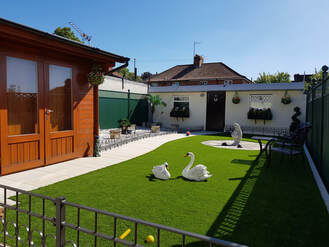
Artificial grass is becoming ever more popular as quality continues to go up and prices continue to come down.

Whilst some people are rightly concerned about the loss of real 'green space' in urban neighbourhoods there are certainly situations where artificial is the best or only option.

A very small space for example, where a mower is not practical, is a good candidate for artificial grass, as are spaces where there is lowe light or drainage issues.


STAGE 1 - EXCAVATION

If you are trying to recreate a similar finished height to what is already there then be prepared for a significant amount of excavation. Depending on ground conditions you are going to need to dig down around 15cm before you can begin resurfacing.

Over a large area this can translate into a lot of soil, earth etc and you are likely to need skips, wheelbarrows and some energetic friends!

Before you start it might be worth calculating roughly what kind of weight of soil you are looking at excavating. If you measure the area in square metres (e.g. 5m by 8m comes to 40 square metres) and then multiply by the depth (e.g. 0.15m) then you will get a cubic metrage of soil etc that needs to come out. Double this and this will be a reasonable estimate in tonnage. So for our example there will be 6 cubic metres or 12 tonnes which equates to around two regular size skips.

Rather that carry out labourious excavation another option is to raise the ground up, although this will genrerally involve constucting low retaining walls.

STAGE 2 - SURFACE PREPARATION

This stage ensures long term stability and sufficient drainage for your new lawn. Trying to cut corners here can result in a waterlogged or uneven surface in the future.

Existing soil conditions will have an impact on stability and drainage and so should be taken into account. A heavy clay soil will, for example, provide additional stability but poor drainage with a softer, sandier soil providing the opposite conditions.

A good rule of thumb is to install a layer of compacted stone ('type 1' or 'hardcore') approximately 10cm thick. It is important to use a vibrating 'whacker' machine to provide a sufficiently solid base and to compact in layers of no more than 5cm each. 1 tonne of type 1 stone will provide a compacted depth of approximately 10cm over 5 square metres so for our example we would need a total of 8 tonnes.

Next comes the layer of 'grit sand' on which the artifical grass itself is installed. This should be installed at a compacted depth of around 30mm. 1 tonne of grit sand will provide this depth for approximately 15 square metres. The sand should be installed a little deep and then 'screeded' to the required level using a large piece of timber or similar.

STAGE 3 - INSTALLATION

Artificial grass generally comes in rolls 2m and 4m wide and so if one of the dimensions of your new lawn is larger than 4m you will need to attach two or more rolls together. This takes some skill and precision and you may want to get professional help with this.

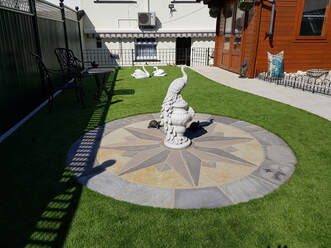
If, as in our example garden, a single roll is sufficient then this should be carefully rolled out over the compacted sand and fixed down.
Picture

There are two main methods for fixing artificla grass down in place. The first is by installing a perimeter timber frame with the timber flush with the compacted sand. The grass can then be tacked down all the way around. Another option is to create a concrete rim around the perimeter and use a suitable adhesive.

Finally the grass is dusted with a very fine sand known as 'kiln dried' sand and this is brushed in until no more can be accomodated. Be sure to do this in very dry weather when there is no moisture around.
0 Comments

How to build garden steps

13/8/2015

3 Comments

 
Picture
Before we get started you should be warned that this is the most advanced of my ‘how to’ guides so far and probably should not be attempted by anyone without some basic experience. Having said this there is only one way to learn and if you are up for a challenge then constructing garden steps can be extremely rewarding.

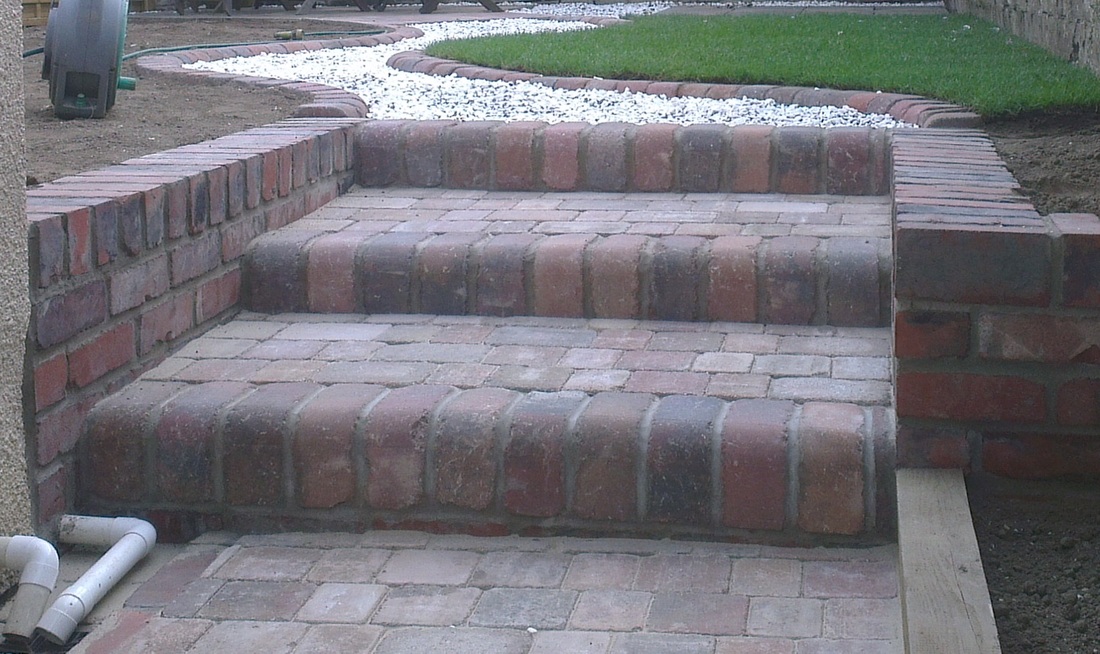
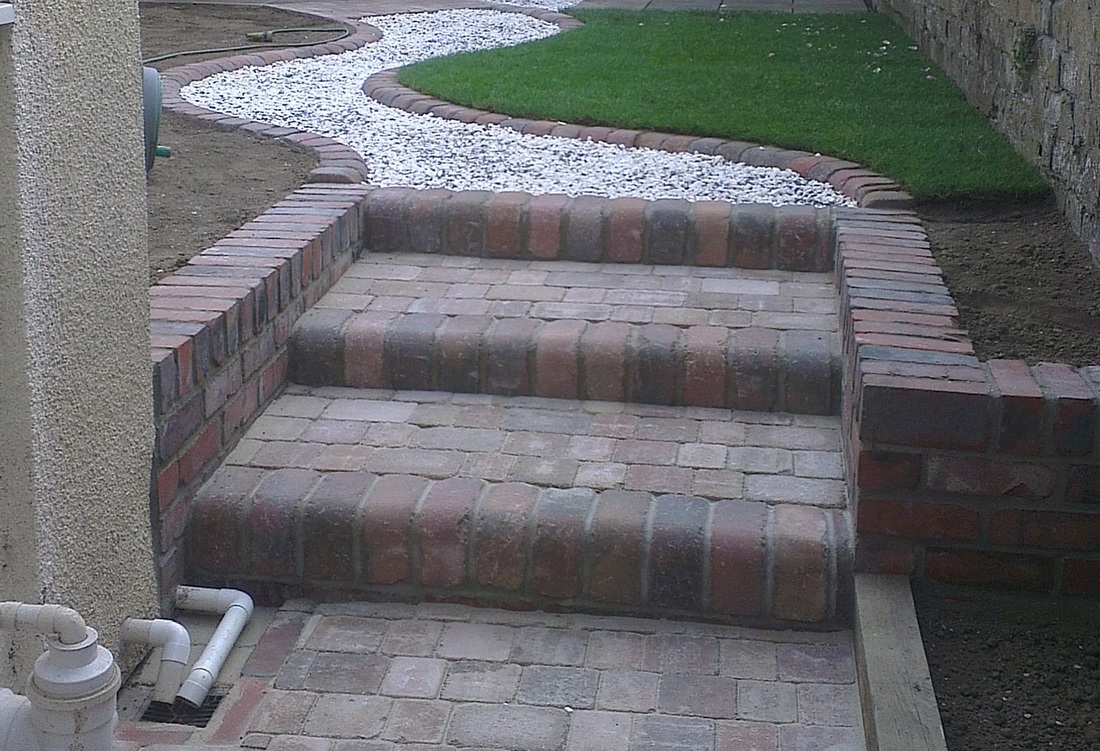
The steps constructed in this example are constructed using reclaimed bricks for the side walls, ‘bull nosed’ bricks for the facing and matching block pavers for the treads. The same basic principles can be used for any steps and so this guide should be adapted to fit your own needs.

Tools required:

Trowel and lump hammer
Wheelbarrow
Cement mixer
Shovel
Spirit levels
Cutting tool such as angle grinder

Materials required:

Ballast
Cement
Sand
Concrete blocks
Facing material if required (e.g. bricks)
Material for treads (e.g. pavers or slabs)

STAGE 1 - EXCAVATION

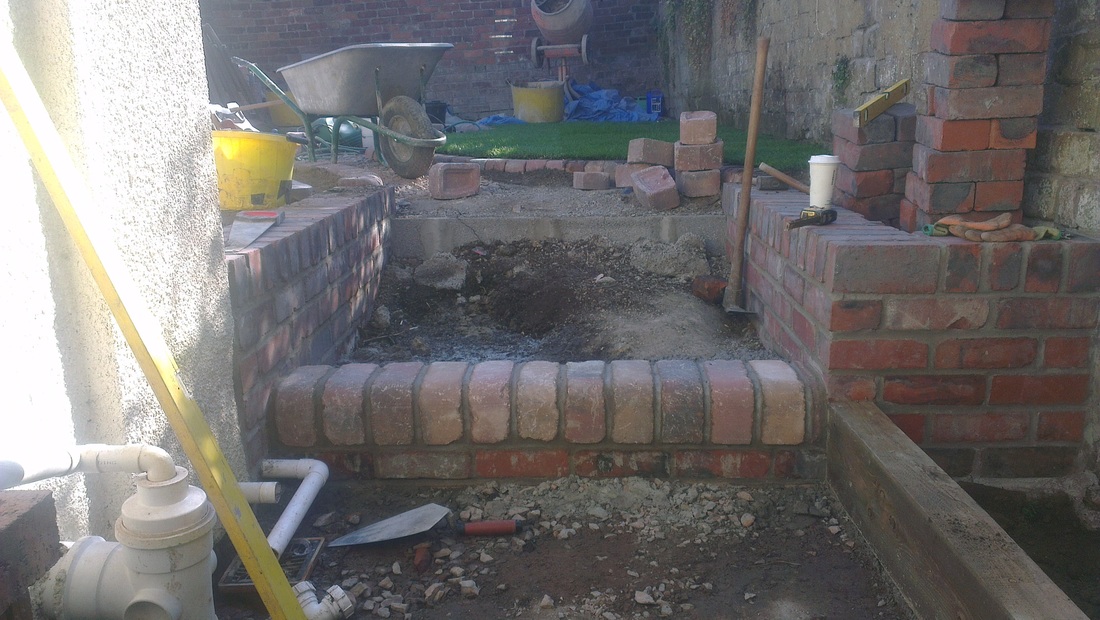
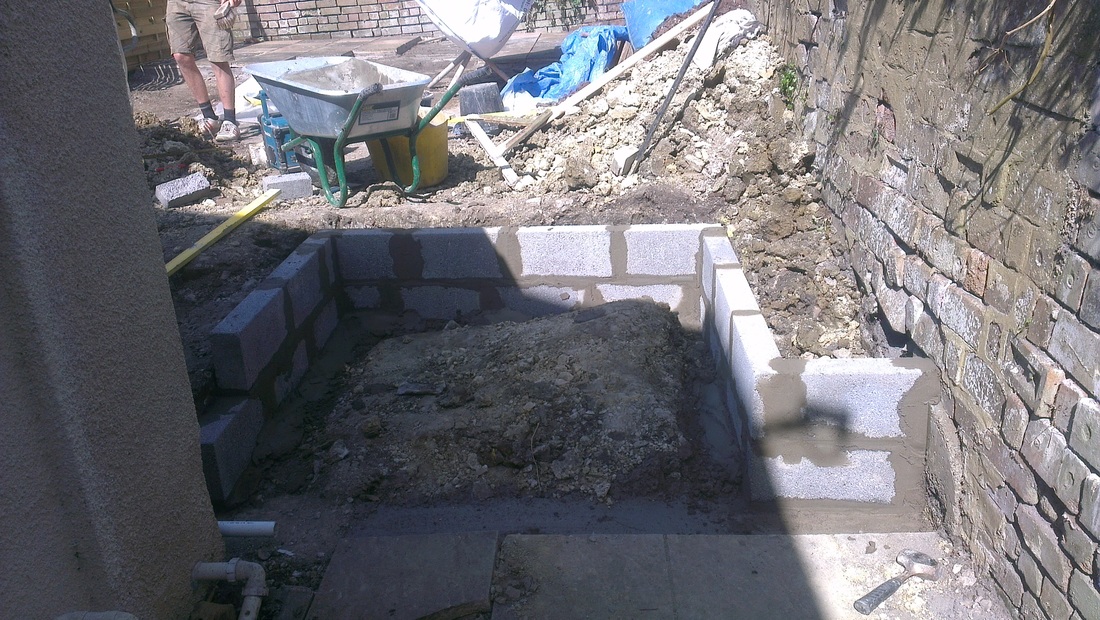
First of all you will need to dig out the area where the steps are going to be constructed. As you can see from the image below you will need to excavate out the entire area to the depth of the base of the steps. This is necessary as a block retaining wall will need to be built around the perimeter of the steps to provide strength and prevent the weight of the raised area creating any problems over time.

You will need to take into account the thickness of the concrete blocks (generally 4 inches) when excavating to ensure there is sufficient room for any walling materials you will use.

STAGE 2 - FOOTINGS

In order to prevent the concrete blocks from subsiding you will need a solid base for them to be built upon. Dig a trench down beneath where the blocks will sit, wide enough to accommodate the blocks themselves plus any walling bricks (if used) plus at least an inch or two either side. For most steps a depth of 25cm should be sufficient.

Now to lay the concrete footings. Make a ballast and cement mix (around 5:1 ratio) and pour into the trench. The finished height of the concrete needs to be level and slightly below the base of the steps. Use the edge of a straight timber board to work the concrete around to achieve a flat surface. Use a spirit level on top of the timber to check the level. You will probably need to redistribute a little of the concrete around before repeating the process and achieving a level footing.

STAGE 3 - BLOCKWORK

If the concrete blocks are to be faced with walling bricks or stone (as in this example), then the blocks can generally be laid on edge as the bricks/stone will provide additional mass and support. If the blocks are to be left exposed or rendered then it is probably advisable to lay them on flat for additional strength.

The blocks should be laid on a sand and cement mortar mix (around 5:1 ratio) using a trowel and making adjustments with a spirit level and lump hammer.
Picture
First of all the outside perimeter of the steps should be defined with blocks as shown in the picture above. It is often a good idea to also install blockwork across for each individual step. In this example, however, the steps are not retaining a great deal and the large bull nosed bricks are sufficient on their own.

STAGE 4 - BRICKWORK (SIDES AND FACES)

The side walls should be faced first taking into account that not all the side walls will be visible as the steps themselves are installed.

Next up are the step faces themselves. In this example we are building them up solely with reclaimed bricks and bull nosed bricks. It may be that you already have blockwork in place to work off.

Picture
As with the blockwork a mortar mix should be used to set the bricks in place. More care needs to be taken here to get the mortar consistency right. Soft enough to provide adequate adhesion whilst not being so thin as to make a mess and stain the bricks.

Before setting each brick in place a bed should be prepared for it to sit on and one side 'buttered' with mortar using a trowel to allow it to bind to the previous brick. Unless you are experienced with brickwork you will probably need to top up the joints with additional mortar. Once the mortar has set to some extent (normally between 1 and 4 hours time) you can use the handle of the trowel to tidy up the mortar joints.

STAGE 5 - BLOCKWORK (TREADS)

With the difficult part done your attention now turns to the step treads.

In this example we simply laid matching block pavers on a compacted bed of sand, cutting them down to size to make a tight fit and then filling any voids with fine 'kiln dried' sand.

And that's it, all done!

Picture
3 Comments

How to build a composter

28/2/2013

1 Comment

 
Picture
A common job for landscape gardeners is the construction of composters. Perfect for the keen gardener these can provide all of your composting needs and are great for the environment.

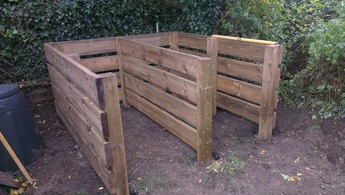
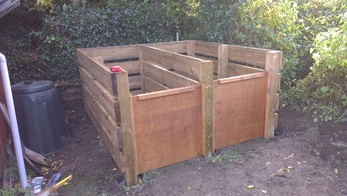
In the example pictures we are creating a double composter. The same principles apply if you creating a more simple single composter.

The tools you will need for this job are: a spirit level, a drill and impact driver, a saw, a spade and possibly a bar. The materials you will need include 3” or 4” posts, 1” by 4” boards, ballast and cement, and screws/timberlockers.

STAGE 1 - CUT THEN STAIN THE SLATS

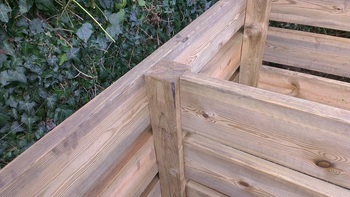
I would suggest using 1” by 4” boards for the slats. First of all decide on the dimensions that you want for your planter and cut the boards to size. The side slats should finish flush with the front and back posts and the rear slats will need to overlap these (two inches wider if using 1” thick boards).

You should leave a gap of roughly 2” between each of the slats for aeration so take this into account when deciding how many slats you will need.

Once the boards are cut to size make sure they are stained for longevity.


Picture
STAGE 2 - DIG AND SET THE POSTS

First you will need to dig the postholes. You will need a spade and possibly a bar if the ground is rocky. The holes should be deep and narrow if possible, to a depth of at least 18 inches.

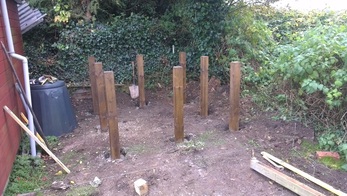
Depending on the size of the planter you will need at least six holes and the planter we are building here requires eight. As you can see from the image the posts are spaced in three lines parallel to each other. The outside lines have three holes for additional support and the centre line has two.

You want the upper slats to be flush with top of the posts if you can. Using a level and tape measure cut the posts to size (test them in the hole to mark where you will cut the post). 3” posts should be enough for a small composter but 4” are recommended for longevity.

Attach the upper slat flush with the top of the posts as they sit in the postholes. Check the level and pack the bottom of a hole with stone to achieve a level if necessary.  Now you are ready to set the first line of posts.

As you will be setting more than one post at the same time I would suggest using a ‘stiff’ ballast and cement mix. This will allow you to make adjustments to the level of the posts whilst providing enough instant support to continue with the other posts without having to wait for the mix to go off.

Now set the second edge line of posts in the same way. Check the finished height is the same using a level before concreting them in. It is advisable to attach the upper back slat to help achieve this.

Finally the middle two posts can be set. Use a level and tape measure to check the line and spacing to ensure they are centrally positioned and level.


Picture
STAGE 3 - ATTACH REMAINING SLATS

The upper slats should already be attached flush to the top of the posts. Use a level as a spacer to determine where the next slat down should be attached.

If you are constructing a double composter then you will also need to insert slats between the two central posts. I would advise measuring the length of these individually incase the posts are not exactly level. You will need lengthy screws/timberlockers to go through the back slat, post and then into the central slat.

If you do not have screws this long you can remove the rear
upper slat to gain another inch. You may need to pre-drill here
if your drill is not up to the challenge.


Picture
STAGE 4 - CONSTRUCT THE DOORS

On each of the front posts you will need to attach two batons (both sides on the middle post if you are constructing a double composter). The doors themselves can be constructed out of ply (1/2 to ¾ of an inch should be sufficient.

Cut the doors to size and stain them. The batons (1” by 1” should do) will need to be screwed into the posts leaving a gap slightly wider than the ply. You may need to pre-drill the batons before you screw them into the posts to prevent them splitting. On the doors themselves screw in a length of baton horizontally near the top to act as a grip.


That's it, your composter is ready to use!
1 Comment

Leaning or damaged fence

17/1/2013

2 Comments

 
Picture
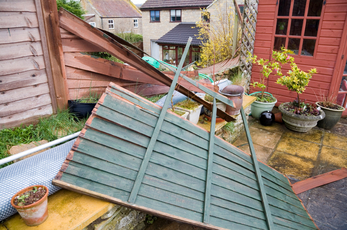
If you have a fence that is damaged or leaning there may be a simple solution. There are three main reasons that a fence needs attention.
  1. Wind damage or weight of foliage
  2. Pushed out by tree roots
  3. Old or rotten fence

The solution will depend on the cause so see whichever section applies to you below. This advice relates to panel style fences. If you have a feather edge fence I would suggest contacting a landscape gardener.

1. Wind damage or weight of foliage.

If the fence has moved due to high winds or weight of foliage then it is likely the posts will need some attention. Ideally you will not need to remove or replace the post and you will be able to reset it in place.

If the post is set in concrete and the entire ball of concrete is moving in the ground when you push the fence then you may be able to dig down around the existing concrete and fill with fresh concrete. Be sure to compact the concrete well and use a level to check the post is set in the correct position.

If the post is sunk using a metal spike then it is probably wise to remove the post entirely and start again. Either unscrew any fixings or lever off any nails attaching the post to the panels. Pull the panels back a little and you should be able to wobble the post free eventually. If it will not come out easily you may need to excavate around the spike a little. Follow the instructions further below on how to set a new post.

2. Pushed out by tree roots.

If a fencepost has been set too close to a tree or large shrub then over time the roots can push the fence out of line. If this is the case you will probably need to set new posts away from the tree roots. Existing panels may need to be cut to size and a new panel may need to be purchased. If you are handy with a saw then set the new posts as explained further below and cut the panels to size. You may need to purchase some timber batons to nail to the cut edge.

3. Old or rotten fence.

If the posts look good and feel solid in the ground then you will just need to break out the rotted panels and screw in a new one. If the posts are also looking a bit rotten it might be time to contact Bristol Landscaping for a new fence.

 
How to set a new fencepost and attach panels
.

Once the existing post is removed you will need to dig a hole at least 45cm (18") deep. You will need a spade or digging spoons and, depending on the ground, you may also need a metal bar. Cut the post to the required length and insert into the hole. You will want to use a fairly dry and stiff concrete mix using a 5 to 1 ballast and cement mix.

Two people will make the job a lot easier from here on in. Pour in the concrete mix in stages and tamp down with a piece of wood whilst keeping a level on the post to achieve the correct position. Once the hole has been filled with concrete (do not fill to ground level, leave at least a couple of inches)) the post should remain in place as the concrete sets.

The panels are easily attached using either hammer and nails or screws and a drill with scredriver attachment. Use a level on top of the fence to ensure they are set level.


If you need help with your fence repairs please contact us.


2 Comments

How to repair wobbly or uneven patio slabs

16/1/2013

3 Comments

 
Picture
An uneven patio or wobbly slabs can be a simple problem that does not necessarily mean it's time to contact Bristol Landscaping and have your patio relaid. If you are prepared to put in a litle time and effort then the problem can often be fixed without calling in a landscape gardener.

If it's just one or two slabs that are wobbly then you will not need to spend more than two or three hours if you have access to a few basic tools. These are a lump hammer and bolster (to break out the old mortar), a bucket or wheelbarrow (to make the morat mix in), spade or shovel (to mix the mortar), a trowel (to lay the new mortar), a rubber mallet (to level and position the slabs) and level or flat piece of wood (to check the finished level).

There are three main causes of wobbly slabs; they have been layed on an uneven bed, they were disturbed before the mortar went off, or the sub base was not sufficient. The first two are easily repaired, and an insufficient sub base will require just a little more effort.

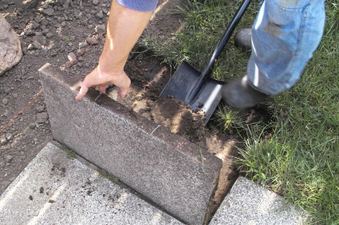
First of all you will need to lift the wobbly slabs. Generally if you get a trowel or spade underneath you can easily lift it out of position. You will then be left with the underlying mortar which will need to be broken out. Use the lump hammer and bolster to remove all underlying and surrounding mortar. Be very careful not to disturb surrounding slabs as they would also need to be relaid.

Now the sub base is visible, is there a good amount of compacted aggregate stone? If so then stamp it down again and you are ready to lay the slab. If the ground is not solid you may want to dig down a little and insert some type 1/scalpings and compact as best you can.

You will now need a mortar mix. You can buy ready mixes from builders merchants where you just add water or you can purchase sand and cement and create a roughly 5 to 1 mix. Do not make the mix too wet by adding too much water.

Insert the mortar mix onto the compacted stone up to the underneath of the slab using the trowel. Test the slab on the mix to see how the height looks. Use the level of piece of wood to check level with surrounding slabs. Use the rubber mallet to attempt to achieve a level with surrounding slabs. It is likely that you will need to lift the slab again and either remove or insert mortar. It is a good idea to work the mortar with the trowel and create an uneven surface to help positioing. Make sure the slabs are sitting on a full bed of mortar.

Depending on the type of slabs there may now be a gap between the newly laid slad and the surrounding slabs. These will need to be filled to prevent the slabs from once again becoming wobbly. You need to make a dry mortar mix (so that you can just make a ball but wil also crumble in the hand). Using the trowel carefullly fill the gaps and either using a pointing tool or a glaved finger compress the mix into the gaps until filled and smooth off as best you can.

That's pretty much it. Keep off them for a couple of days if possible and all should be well.

If you need help with this, or any other landscaping project, please contact us.

3 Comments

    Dave Bruton

    I have been in the landscaping business for 15 years. I greatly enjoy the work and every day I learn something new.

    If you live in the Bristol area and need help with any aspect of landscape gardening please get in touch via our contact page.

    Archives

    July 2019
    August 2015
    February 2013
    January 2013

    Categories

    All
    Bristol
    Damaged
    Fence
    Fencing
    Garden
    Gardening
    Landscapers
    Landscaping
    Leaning
    Patios
    Uneven
    Wobbly

    RSS Feed

Proudly powered by Weebly